
Ethical Currencies and Economic Models
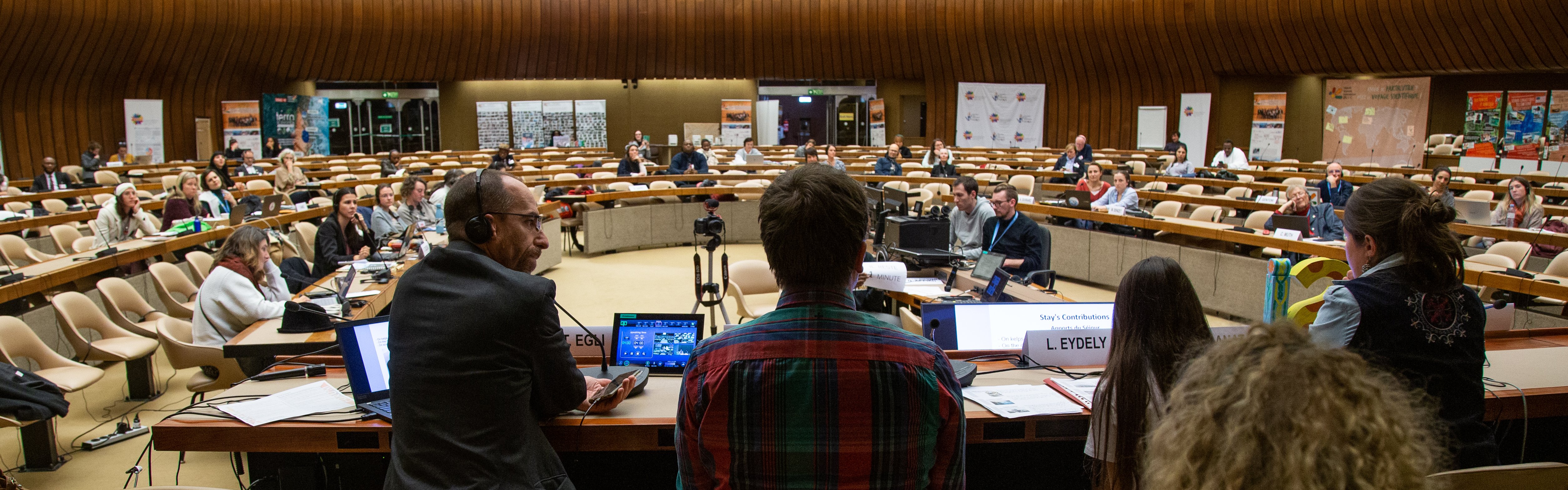
With its first edition in 2001 and a strategic renewal in 2015, the International Annual Conference on Responsible Finance, Economic Models and Digital Currencies for Peace and Sustainable Development has been an annual milestone for advancing solutions and agile tools available to stakeholders in the field.
"Bio-inspired economic models for developing profitable impact projects."
Wednesday, 9 December 2026, Geneva, Switzerland. Registration required, see below
In partnership with



|
Frame
At a time when International Geneva is facing a major polycrisis and seeking new sources of revenue and prosperity, and while various global economic regions such as Europe are confronted with the need to reindustrialize and with the economic decline highlighted by the Draghi Report, it has become urgent to rethink our economic foundations and their models of daily functioning. The questioning of globalization as established since the WTO opens a strategic window to explore sustainable, resilient, and value-creating alternatives.
Bio-inspired economic models represent a major pathway: they are rooted in the principles of nature — cooperation, circularity, resilience, energy optimization — to define new economic frameworks capable of generating wealth and jobs while reducing vulnerability to market shocks (inflation, global fluctuations). By mobilizing ecosystem services as levers, these models can transcend current paradigms and enable impact projects to fully deploy themselves within a renewed economic environment.
The interactive workshop will be structured in three parts:
- Two introductory presentations on bio-inspired economic models and their concrete applications (Europe, International Geneva, strategic sectors).
- An interactive exchange with the audience based on SMART questions, through polls, word clouds and live co-creation, to identify challenges and opportunities.
- A project pre-dimensioning workshop, aimed at laying the first milestones for a bio-inspired economic framework adapted to impact projects and their scaling-up.
Participants will contribute to:
- Analyzing bio-inspired models already tested in various European territories or in selected success stories of International Geneva.
- Identifying key success factors and obstacles encountered.
- Determining the conditions for scaling-up and the public-private tools to be mobilized.
- Drafting concrete pathways for European reindustrialization and a new prosperity for International Geneva based on bio-inspired economics.
Final objective: to provide impact and high-impact projects with economic models that go beyond current logics, creating a new economic environment where they can fully unleash their potential for wealth generation and positive impact.
Discussions among stakeholders in this meeting take place both as a Round Table with the speakers and in breakout group debates involving the Assembly audience.
Geneva - Wednesday, December 9, 2026, Morning
This annual collaborative space allows stakeholders in the field to share practices, challenges, solutions, ideas, and needs.
Participation options
You can:
- Attend the conference of your choice in person with your membership,
- Participate throughout the week with an impact project or come and join a project on site,
- Submit a content proposal for the conference (see further down this page),
- Get involved in running the event by choosing the appropriate membership (young people aged 16 to 25, see section Youth Geneva Forum).
Call for Contributions
| What proposals for "smart" currencies serving sustainable development? See the call for contributions here. |
Proceedings from Previous Years
View this section.
Program
SCHEDULE AND SPEAKERS
| ▪ 09:00 AM - 10:00 AM: Welcome to the room and one-on-one meetings |
| ▪ 10:00 AM: Conference Opening, Introductory Notes and Protocol, Session Introduction M. Thomas EGLI, Host of the Geneva Forum (Geneva Forum) and Session Chair, Switzerland |
| ▪ 10:10 AM - 10:30 AM: Pitch Round (6 min. max. per speaker) |
| ● David FRENCH, My Drop in the Oceans Beyond Ethical Currency: When Does Recognising Ecological Value Actually Change Economic Decisions? |
| ▪ 10:30 AM - 10:35 AM: Presentation of the question to work on. |
| ▪ 10:35 AM - 11:15 AM: Interactive Roundtable (Feedback Session) Facilitated by Thomas EGLI |
| ▪ 11:15 AM - 11:30 AM: Break |
| ▪ 11:30 AM - 12:45 PM: One-on-one meetings session |
| ▪ 12:45 PM - 01:00 PM: Closing Remarks |
| ▪ 01:00 PM: End of the Workshop |
| From 1:00 PM: Networking Opportunities (Networking) |
| At the end of this session, a position paper will be published by the Geneva Forum to compile what was discussed and decided during the session. |
| ▪ 07:00 PM: Geneva Forum Networking Dinner |
Registration and Memberships
During the Geneva Forum, you can be a member of the audience, contribute ideas for Impact Projects or be in the process of scaling up Impact Projects, propose a Poster presentation, or submit a conference proposal to be delivered at the event. (Deadline for submitting an abstract: see the call for contributions for the conference)
To participate in the Geneva Forum, you must subscribe to the Membership "Event".
| By subscribing to one of the memberships, you become a member for a period of one year. |
Once your membership has been validated, you will receive all the necessary logistical information, as well as the link to generate your badge for each event, a few days beforehand.
|