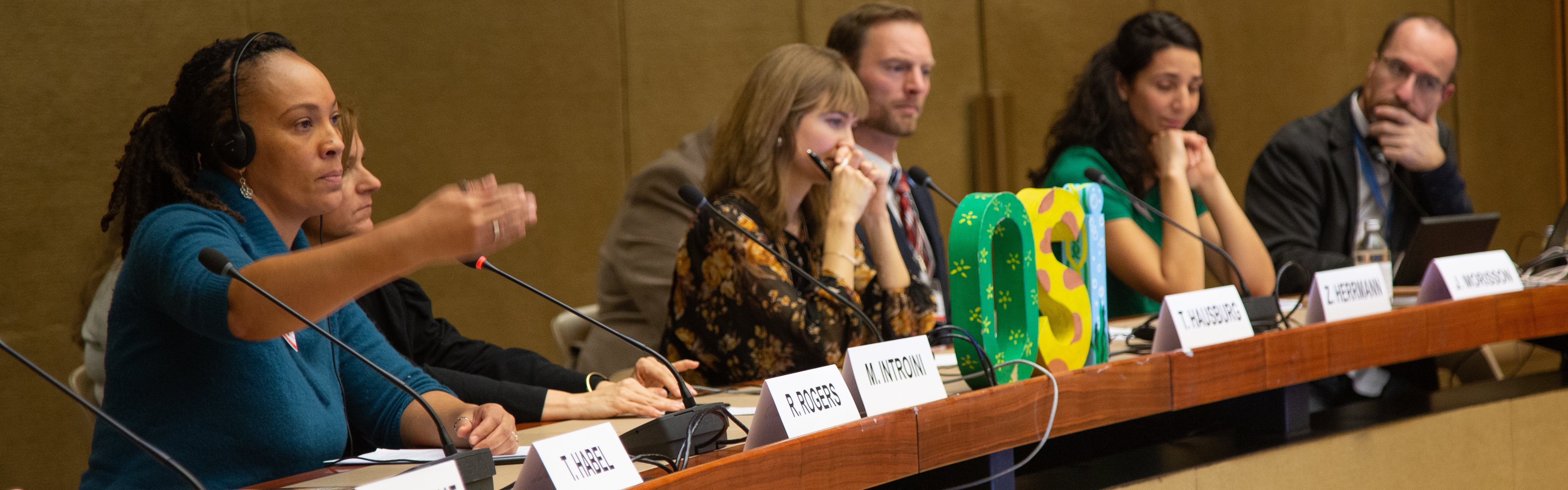
With its first edition in 2001 and a strategic renewal in 2015, the International Annual Conference on Inclusive Education and Project-Based Pedagogy for Peace and Sustainable Development has been an annual milestone for advancing solutions and agile tools available to stakeholders in the field.
"Project-based learning and cross-disciplinary impact projects for addressing the Goals of International Geneva and UN."
Thursday, 10 December 2026 in Geneva, Switzerland – registration required, see below
In partnership with

To read all the content, log in to the website for free.
|
Framework
Project-Based Learning: a lever for the future of nations and International Geneva
In global economic competition, countries that adopt Project-Based Learning (PBL) gain a decisive advantage in terms of education, innovation and competitiveness. Those that remain anchored in the industrial model inexorably fall behind.
This workshop will highlight PBL as an efficient and effective solution for achieving teaching and education objectives, ensuring the success of nations and training the talents capable of meeting tomorrow’s challenges.
This workshop will also explore PBL as a powerful cross-cutting project channel for International Geneva, offering a mobilizing framework for action that attracts and federates major fortunes, philanthropists and impact investment funds seeking truly transformative projects with strong systemic reach.
Project-Based Learning is not only an educational method, but also a strategic lever for the economic and diplomatic future, serving high-impact projects.
Discussions between the stakeholders of this meeting take place both in the form of a Round Table between the speakers, and in the form of subgroup debates involving the Assembly audience.
| Geneva - NYC - Bangkok - Nairobi |
Geneva - Thursday, December 10, 2026 afternoon
| 13th Annual International Conference on Inclusive Education and Project-Based Learning for Peace and Sustainable Development |
This annual sharing space enables actors in the field to pool practices, challenges, solutions, ideas and needs
Call for Contributions
Proceedings from past years
View this section.
Program
PROGRAM AND SPEAKERS
| ▪ 14:00-15:00: Welcome in the room and one-on-one meetings |
|
▪ 15:00: Opening of the Conference, introductory notes and protocol, introduction of the session
Mr. Thomas EGLI, Host of the Geneva Forum (Geneva Forum) and Chair, Switzerland |
|
| ▪ 15:10-15:30: Pitch round (6 min. max. per speaker) |
|
● Jérémy LABOURE, EARTH CARE MOVEMENT Eco-Anxiety : an untapped potential for shaping the Leaders of Tomorrow
In the face of environmental, social, and informational crises, many young people experience what is commonly referred to as eco-anxiety. Yet this concern should not be viewed as a disorder to be corrected, but rather as a form of lucidity toward the realities of our world and a valuable educational resource when properly supported. Drawing on Earth Care Movement’s field experience with thousands of young people, this presentation will explore an approach based on action research and project-based learning. Our methodology starts from young people’s initial perceptions of the world, their emotions, questions, and aspirations, in order to build meaningful pathways toward engagement and action. Because it is difficult to act upon the world without first understanding oneself, we create spaces for dialogue that foster self-awareness, critical thinking, and a stronger sense of agency. Finally, this presentation will highlight the importance of co-creation between young people, educators, health professionals, and institutions. In a context marked by increasing social fragmentation, we advocate for cooperation, mutual support, and adult role-modeling as essential conditions for educating citizens capable of collectively addressing the challenges of the 21st century. Our ambition is to transform concern into engagement and to make education a driver of resilience, peace, and sustainable development.
|
|
● OSI Team, ONG Objectif Sciences International How can international organizations create long-term pathways that enable young people to evolve from participants to project leaders, researchers and decision-makers within international cooperation?
How can we build pathways that enable young people to progressively develop skills, autonomy and responsibility within international cooperation? This presentation will explore how international organizations can create long-term pathways allowing young people to gradually move from participation to positions of greater responsibility: first contributing to projects, then developing skills and expertise, taking responsibility for research or operational activities, and eventually participating in project design, governance and decision-making. Today, young people are still often involved as participants, beneficiaries or occasional contributors, without necessarily creating the steps that would allow them to remain engaged and evolve over time. The challenge is therefore to consider youth participation not as a one-off activity, but as a continuous process of learning, capacity-building, empowerment and transmission. Creating continuity between education, participatory research, project implementation and institutional spaces could help build a new generation of project leaders, researchers and decision-makers fully engaged in international cooperation and sustainable development.
|
|
● Thomas EGLI, Geneva Forum From Consultation to Co-Creation: How can Geneva-based organizations give young people a real role in shaping projects, research and decision-making?
Youth participation is increasingly recognized as an important principle within international organizations. Yet in practice, young people are still often treated as beneficiaries, consultees or invited participants, rather than as genuine partners in the design of projects and public policies. This presentation will explore the conditions needed to move from consultation to genuine co-creation, where young people are not only invited to express their views, but actively contribute to defining priorities, designing projects and research, developing solutions, and participating in governance and decision-making. It will examine how Geneva-based organizations can create concrete mechanisms to share responsibility and decision-making power with young people, while ensuring that their participation has a real and visible influence on outcomes. The objective is therefore to move beyond assessing youth participation simply by how often young people are consulted, and instead consider the actual influence, responsibility and agency they are given throughout the lifecycle of a project or public policy.
|
|
● Dr. Rhianna C. Rogers, The Sustainable Progress and Equality Collective (SPEC) & the Global Online Education Regulator (GOER) Operationalizing the Regulatory Sandbox: Cross-Sector AI Governance in Global Education
Context & Problem: Isolated, hyper-local educational technology pilots consistently fail to scale, lack cross-sector architectures, and collapse when short-term funding ends. Educational ecosystems remain structurally fractured between rigid, top-down theories and uncoordinated field initiatives that lack a unified, auditable regulatory baseline. Core Objective & Alignment: This proposal presents the Global Inclusive Education Ecosystem (GIEE) Regulatory Sandbox as a Transition-Engineered macro-governance architecture. It aligns directly with international resilient policy benchmarks by converting decentralized field data into validated, bankable global AI governance standards for the United Nations-Geneva Forum. Key Themes/Arguments: The methodology coordinates three systemic layers. First, it anchors diverse pilots within two compliance engines: the Global Learner Quality Framework (GLQF), which tracks lifecycle digital competency, and the Global Online Education Regulator (GOER), which enforces data sovereignty. Second, it subjects varied cross-sector pilots including Women in AI (MSMU/University of Barcelona), murmur Clinical AI, and Street Racket to identical evaluation rubrics. Third, it implements architectural constraints like Human-in-the-Loop (HITL) safeguards and data-collection ceilings to prevent algorithmic bias and metric creep. Stakeholder Engagement & Methodology: Utilizing an interactive session led by the GIEE Secretariat, this proposal brings together case study leads, international policymakers, and technical experts. It showcases a self-replicating Tiered Leadership Pyramid that scales design authority without operational burnout. Expected Outcomes & Policy Impact: Participants will receive an empirically validated model for a multi-sector vetting engine. This framework equips the Geneva Forum with a defensible infrastructure to regulate human-centered AI systems, protecting participant data sovereignty while fostering global educational equity.
|
|
| ▪ 15:30-15:35: Statement of the question to be addressed |
|
| ▪ 15:35-16:15: Interactive round table (feedback session) Hosted by Thomas EGLI |
|
| ▪ 16:15-16:30: Break |
|
| ▪ 16:30-17:45: One-on-one meetings session |
|
| ▪ 17:45-18:00: Closing remarks |
|
| ▪ 18:00: End of the workshop |
|
| ▪ 19:00: Geneva Forum Networking Dinner |
At the end of this session a position paper will be published by the Geneva Forum to compile what was said and decided during the session.
Registration and Membership
During the Geneva Forum, you can be a member of the public, contribute to impact projects or participate in the impact project development process, propose a poster presentation or submit a proposal for a presentation to be delivered during the event. (Deadline for submitting an abstract: see the call for contributions for the conference)
To participate in the Geneva Forum, you must subscribe to the “Event” Membership.
| By subscribing to one of the memberships, you become a member for a period of one year. |
Once your membership has been validated, you will receive all the necessary logistical information, as well as the link to generate your badge for each event, a few days in advance.
To read all the content, log in to the website for free.
|