
Aligning International Geneva and Impact Finance? Report on the Official Opening Session of the 17th Geneva Forum at the UN, December 8, 2025
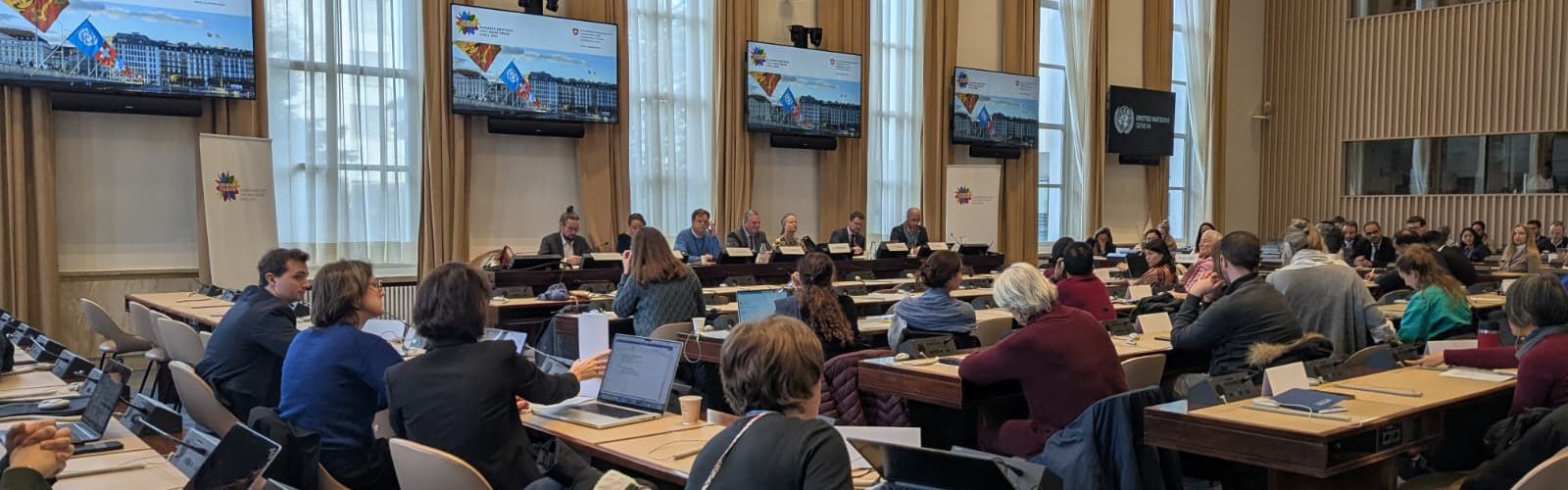
This report presents the key elements from the morning session of Monday, December 8, 2025, organized by the Geneva Forum at the Palais des Nations (Room XII), as part of the annual conference “Impact Finance, Investment, Philanthropy and Blended Finance for Peace and Development,” co-endorsed by the Permanent Mission of Switzerland to the United Nations in Geneva.

This day was part of the effort to sustainably bridge two of Geneva’s longstanding pillars, which have coexisted for decades, yet whose logics remain difficult to align in daily practice.

  • On the one hand, International Geneva and the multilateral ecosystem (intergovernmental organizations, permanent missions, NGOs, foundations, and associations), currently weakened by the rapid evolution of traditional funding streams;
  • On the other hand, Geneva’s financial center, with its strong expertise, significant assets under management, and growing momentum in so-called impact finance.

The challenge is simultaneously economic, institutional, and strategic: to preserve and strengthen a vital ecosystem for the region, while developing financing models that are compatible with the imperatives of peace, accountability, and performance in service of the common good.

This “Impact Finance” morning session was thus conceived as a moment of alignment: to share a clear-eyed diagnosis, clarify opportunities, identify tangible levers (investment, philanthropy, blended finance), and lay the groundwork for more understandable, fundable, and replicable transdisciplinary impact projects, capable of supporting the UN system, NGOs, local authorities, and economic actors.

This report therefore pursues a simple goal: to preserve a faithful record of the key messages, points of convergence, and operational pathways that emerged, in order to inform the remainder of the bootcamp and help build future collaborations at the intersection of finance, sustainable development, and multilateralism.

List of Speakers and Their Organizations

Thomas EGLI (Geneva Forum) recalled the mission of the Geneva Forum since 2001 – linking finance and cooperation, turning silos into bridges – and presented the in-depth work carried out by the finance-science-entrepreneurship collective he has coordinated since 2022, in the context of the creation of the Geneva Foundation for the Future and the AGILE tool for the Impact Finance;

Vincent CONUS (Permanent Mission of Switzerland to the UN in Geneva) announced a funding commitment of 250 million Swiss francs to support Geneva as a multilateral capital through tools such as the SDG Impact Finance Initiative and Building Bridges;

Béatrice FERRARI (International Affairs Directorate, Canton of Geneva) highlighted the agility of local institutions as drivers of innovation;

Vincent SUBILIA (Geneva Chamber of Commerce, Industry and Services) affirmed the compatibility of sustainability and profitability, citing GINGA and Trust Valley;

Anthony MILLER (UNCTAD, Stock Exchange Initiative) promoted sustainable stock exchanges as a way to integrate human rights into finance, with UN-supported guides on modern slavery;

Careen ABB (UNEP Finance Initiative) described how this initiative helps banks align their impact with SDG goals, shared taxonomies, and harmonized reporting;

Boris Le MONTAGNER (Building Bridges) positioned sustainable finance as a central pillar of global economic transformation.

To understand the background of this event, see the archive for December 8, 2025.

A Convergence of Warnings and Opportunities: A Turning Point

The morning session highlighted a cross-sector consensus: International Geneva is undergoing a critical phase, marked by both vulnerabilities and a rare window for action. On one side, the real risk of a gradual erosion of the “Geneva cluster” (relocations, budget cuts, weakening of the NGO–UN fabric), alongside growing pressure on traditional public funding. On the other, a global demand for more robust responses to systemic crises (climate, conflicts, human rights, political fragmentation, biodiversity collapse, cyber threats).

In the background, the contraction of multilateral funding is described as a major risk for the ecosystem, with an estimated order of magnitude involving around 150,000 jobs and 5 billion in potential annual economic impact.

In this context, Geneva remains one of the few places where diplomacy, finance, research, industry, humanitarian work, and innovation can co-construct systemic responses in a trusted environment.

Key Levers to Transform the Economy

Sustainability is no longer a moral option: it is a strategic imperative.
A common vision is emerging: Sustainability → Resilience → Security → Prosperity, presented as a structuring sequence (a central message reiterated by the Permanent Mission of Switzerland). Sustainability thus becomes a condition for economic, geopolitical, and social stability.

Sustainable finance does not replace public aid: it extends it.
The goal is not to replace public with private funding, but to design hybrid mechanisms (blended finance) capable of reducing risk, attracting private capital, and ensuring real, measurable impact. The challenge is institutional: mechanisms, skills, and governance must make this hybridization truly operational and scalable.

The morning session also recalled Switzerland’s commitment of around 250 million CHF over four years to strengthen Geneva as a multilateral capital, with cited levers including the SDG Impact Finance Initiative (goal: 1 billion CHF by 2030) and Building Bridges, while solutions such as AGILE from the Geneva Foundation for the Future or T-HOTS (a digital treasury tool) are deemed useful and relevant.

The Geneva Cluster: A Strategic Global Asset to Protect

The Geneva cluster is described by all present actors, including the International Affairs Directorate and the Geneva Chamber of Commerce, Industry and Services, as a global competitive advantage based on:

  • the physical proximity of actors,
  • the diversity of expertise,
  • a culture of dialogue rather than polarization,
  • the ability to produce laws, standards, protocols, and global tools,
  • credibility and neutrality.

Shared message: losing this cluster would be irreversible; strengthening it is a decisive investment.

A concrete example of this standardization capacity was recalled: the Sustainable Stock Exchanges (SSE) Initiative, a UN partnership involving over 130 stock exchanges, illustrating Geneva’s ability to align finance with standards.

Need for a Common Language: Standardizing the Notion of Impact

A recurring point: actors (public, private, humanitarian) use different reference frameworks, while standards are multiplying (SBTi, IRIS+, ISO, BCorp, PRI, TNFD…) without sufficient coordination. The absence of a shared language slows impact investment and undermines credibility.

Operational conclusion: building a coherent system to measure, manage, and compare impact is becoming a growth factor for impact finance.

This convergence effort is also being driven by financial institutions, through approaches such as the Principles for Responsible Banking of the UNEP Finance Initiative (portfolio analysis, targets, action plans) and standardization efforts (Impact Management Platform, engagement with regulators on taxonomies and reporting).

“Modelable,” Simple and Scalable Technological Tools

Observation: projects lack simple, clear, and interoperable tools. The AGILE tool for impact finance — which will undergo its Dry Run during this Geneva Forum — is mentioned as a potential pivot, particularly for:

  • decision support,
  • reliability analysis,
  • quantified and visual evaluation,
  • project consolidation into scalable pathways,
  • systemic mapping.

Strategic objective: move from isolated projects to structured portfolios and a resilient impact project ecosystem.

The idea is to have a tool that connects multiple frameworks (B-Corp, IRIS, ISO…) and serves both to equip and foster progress (mentorship) and to select.

Transparency, Sharing, Usability: Conditions for Adoption

Several speakers stressed the need to make funding and tools readable, universal, transparent, and accessible.

Capacity-building efforts must target both youth and institutions (NGOs, states, organizations), to increase their internal capacity to mobilize funding and maximize impact.

The challenge also involves a shift in mindset: from a logic of charity to one of investment / leverage, and strengthening internal capacities (partnerships, impact measurement, digital transformation) to make organizations more fundable.

Do Not Forget Hard-to-Fund Sectors: Peace, Human Rights, Disarmament

Strategic alert: these sectors do not yield direct financial ROI, but form part of Geneva’s core identity and are severely weakened by budget cuts. Sustainable finance must invent creative mechanisms and connections to include these areas and enable deep impact.

Core idea: sustainability without peace and human rights has no foundation.

The situation on the ground is concerning: shrinking of the Humanitarian Hub (now fewer than 100 people), relocations, and urgent need for adapted mechanisms (including dedicated bridges between humanitarian action and finance).

Forum Objectives (for the Week): From Diagnosis to Fundable Projects

Foster a common language of impact: harmonize methods, clarify indicators, align tools, produce a shared “methodology kit.”

Structure multi-stakeholder coalitions and co-create scalable projects, via:

  • indicator testing,
  • use of AGILE and workshops to surface “finance-ready” proposals,
  • creation of public–private alliances,
  • partnerships between states, businesses, and NGOs,
  • thematic consortia (climate, peace, biodiversity, food systems, responsible digital),
  • proposals compatible with investors and institutions.

Related actions:

  • secure Geneva’s position as a governance platform,
  • document the importance of the cluster,
  • convince governments to support their presence,
  • multiply stabilizing mechanisms (adaptation funds, private companies, philanthropy, facilities for NGOs).

Mentioned success criteria:

  • quality → sustainable profitability (economic and societal),
  • quantity → achieving scale for transitions,
  • replicability → from municipal to continental level.

Conclusion of the Morning Session

The morning laid the foundations of a movement: bringing actors together, defining a shared language, realigning finance with sustainable development missions, equipping for scale-up, protecting and strengthening the Geneva ecosystem, and embedding impact in economic decision-making while preserving human rights, peace, and biodiversity as pillars.

Immediate goal for the rest of the week: turn this shared diagnosis into prototypes, then into structured, financed, and scalable projects.


Closing Remarks by the Geneva Forum

We thank all speakers and participants in the room for the quality of the discussions and the collective maturity expressed throughout the morning.

In Geneva, impact finance is not a slogan: it is a scaling discipline, a method of cooperation, and a shared responsibility to connect the economy to life.

One thing is clear: the needs exist, the capital exists, the expertise exists — but we still need to strengthen the shared language, tools, and trust mechanisms that allow intentions to become truly fundable, measurable, and deployable impact projects.

The Geneva Forum will continue this work by facilitating:

  • the structuring of inter-silo, transdisciplinary projects capable of engaging organizations from International Geneva,
  • the consolidation of public-private or blended finance partnerships,
  • the visibility of business models and impact pathways,
  • and the collective tools needed to move from diagnosis to action, enabling both return on investment and mission fidelity.

We invite all those who wish to contribute to this dynamic to stay engaged in designing transversal and structural impact projects, to join the proposed working formats, and to continue the conversation toward the next steps and formalized alliances.

Geneva Forum

If you want to follow the progress of the Geneva Forum, please visit the website via the burger menu or contact the team.

Report finalized and released by Mr. Thomas EGLI, CEO of the Geneva Forum, and Mrs Chloé LAROSE, Deputy Director of the Geneva Forum, based on detailed notes taken by Ms. Cécile CAMPAGNE, member of the organizing team.